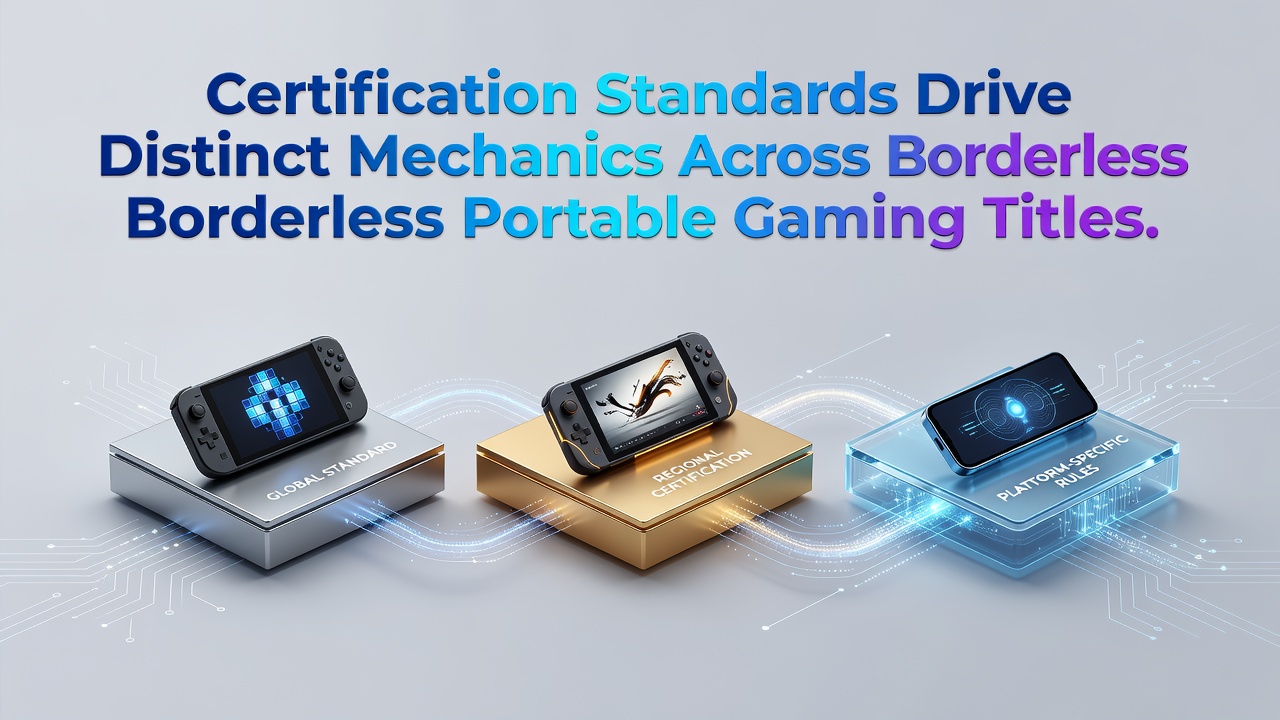
Certification Standards Drive Distinct Mechanics Across Borderless Portable Gaming Titles
Certification standards from multiple regulators create varied game mechanics in portable titles that operate across jurisdictions, and developers adjust features like random number generators, bonus triggers, and payout structures to meet each set of requirements while maintaining playability on mobile devices. These adjustments become necessary because portable gaming platforms distribute the same core title in regions governed by different oversight bodies, which leads to region-specific versions that users encounter depending on their location and device settings.
Divergent Approval Pathways Shape Core Systems
Regulators in various markets require distinct testing protocols before a title receives approval, and these protocols directly influence how mechanics function once the game launches on borderless platforms. For instance, testing bodies examine random number generator performance under specific load conditions, while others focus on how bonus rounds interact with player input sequences, and developers implement separate code branches to satisfy each examiner. Data from June 2026 shows an increase in multi-jurisdiction submissions, where companies submit parallel builds that differ in volatility settings and feature frequency to align with local rules without altering the overall theme or artwork.
One study from the Alcohol and Gaming Commission of Ontario highlighted how certification timelines affect deployment schedules, noting that titles passing Canadian standards often include tighter controls on autoplay functions compared with versions cleared elsewhere. Those controls translate into mechanics that pause more frequently or require explicit confirmations, and mobile users notice these pauses when switching between accounts registered in different regions.
Mechanics Adaptations in RNG and Bonus Design
Random number generator certification remains a central point of divergence, since each authority specifies its own statistical thresholds and testing intervals. Titles that clear one set of standards may feature bonus activation rates calibrated to stricter variance limits, while versions approved under another framework allow slightly wider distribution curves that change how often players reach high-value outcomes. Software providers maintain separate databases for each certified build, which ensures compliance yet creates observable differences when the same portable title runs on devices located in separate markets.
Bonus round structures also diverge because some regulators demand explicit disclosure of trigger probabilities within the game interface, and others require additional animation sequences that extend play duration. These requirements force developers to embed conditional logic that activates only in approved territories, and users accessing the game through borderless networks sometimes experience altered sequences when their connection routes through different servers.

Regional Examples and Implementation Patterns
European markets cleared under standards from the Malta Gaming Authority often see mechanics that incorporate mandatory cooling-off prompts after extended sessions, and these prompts integrate directly into the bonus cycle rather than appearing as external overlays. In contrast, titles approved by the Nevada Gaming Control Board tend to emphasize seamless transitions between base game and feature rounds, with fewer mandatory interruptions. Observers note that developers manage these differences through modular code libraries, which allow quick swaps of certified components when releasing updates for specific regions.
A report issued by the Australasian Gaming Council in early 2026 documented how certification variations influence retention metrics across portable platforms. The figures reveal that games carrying multiple approvals display different session lengths depending on the active certification profile, and operators track these patterns to optimize server routing for users in overlapping jurisdictions. Such tracking occurs without storing personal data, focusing instead on aggregate mechanic performance data.
Challenges for Developers and Operators
Borderless distribution adds complexity because a single portable title must function correctly under every active certification while preserving consistent user experience where possible. Companies address this by maintaining detailed compliance matrices that map each mechanic to its corresponding regulatory requirement, and updates in June 2026 reflected expanded matrices that now cover emerging standards around in-game advertising and cross-device synchronization. These matrices help teams identify which features require separate certification paths before global rollout.
Testing laboratories also adapt their processes, running parallel evaluations for the same title under different rule sets, and the results feed back into build pipelines that generate region-locked executables. Mobile platforms then serve the appropriate version based on detected location or account registration, which reduces the risk of non-compliance while preserving the distinct mechanical identities shaped by each certification standard.
Conclusion
Certification standards continue to drive mechanical differentiation across portable gaming titles that reach users regardless of borders, and the resulting variations appear in random number generator behavior, bonus frequency, and session management features. Data collected through June 2026 confirms that operators and developers maintain separate certified builds to satisfy multiple authorities simultaneously, which creates observable differences for players depending on access routes. These patterns are expected to persist as new regulatory frameworks emerge and portable platforms expand their reach into additional markets.